
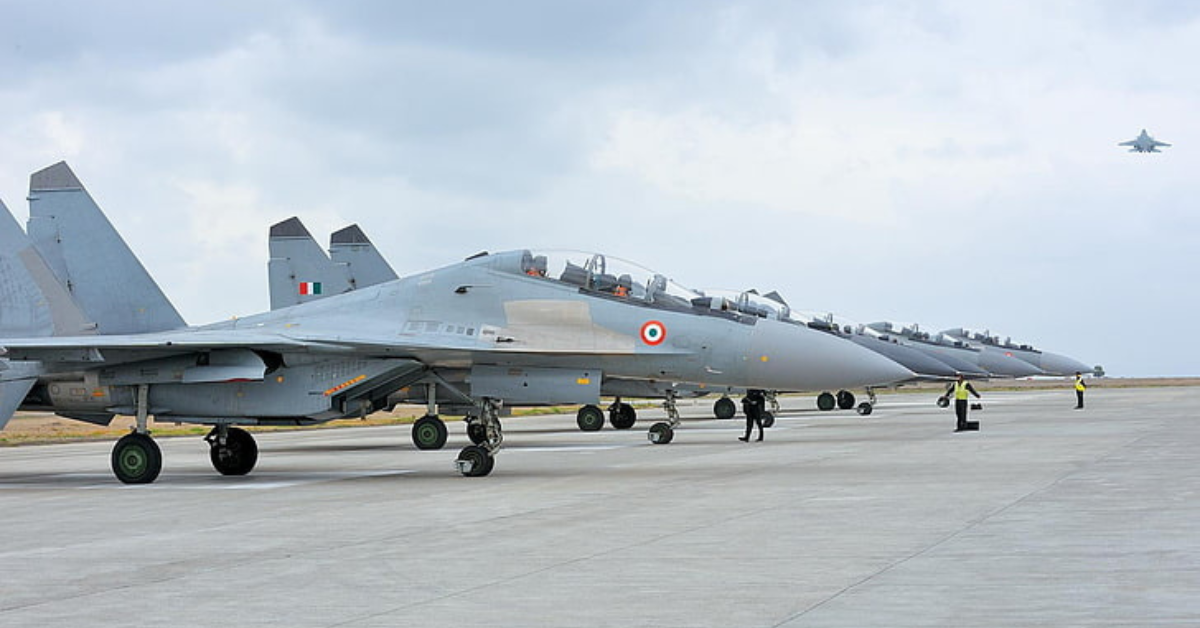
In a historic achievement for India’s defence establishment, the Indian Air Force (IAF) has officially been ranked the third most powerful air force in the world, surpassing China’s People’s Liberation Army Air Force (PLAAF). The recognition comes from the World Directory of Modern Military Aircraft (WDMMA) 2025 report, which evaluates the operational strength, technological sophistication, and readiness of air forces across the globe.
This development marks a turning point in India’s long-term efforts to modernize its aerial capabilities and establish itself as a dominant air power in the Indo-Pacific region.
Understanding the Ranking
The WDMMA’s “TrueValue Rating” (TVR) is not based merely on the total number of aircraft. Instead, it measures the overall combat effectiveness of an air force — considering factors such as fleet diversity, modernisation level, training quality, logistics, and indigenous manufacturing capacity.
According to the 2025 rankings, the IAF achieved a TVR score of 69.4, while China’s PLAAF scored 63.8. The United States Air Force and Russia’s Aerospace Forces continue to hold the top two positions respectively. Interestingly, while China has a numerically larger fleet (estimated at over 3,000 aircraft), India’s superior balance, operational readiness, and modernization pace have helped it move ahead in capability.
Key Reasons Behind India’s Rise
1. Balanced and Versatile Fleet
The IAF maintains a balanced mix of fighters, helicopters, transport aircraft, and training platforms. Its fleet comprises approximately 32% fighter aircraft, 29% helicopters, and 22% trainers, ensuring flexibility across missions — from combat operations to humanitarian relief. China, on the other hand, has a higher share of fighters but fewer multi-role or transport assets in proportion, making its force less adaptable.
2. Modernisation and Self-Reliance
Over the past decade, the IAF has undergone rapid modernization. The induction of Dassault Rafale jets, upgraded Sukhoi Su-30MKI fighters, and the indigenous HAL Tejas Mk1A have enhanced its strike and defence capabilities. Upcoming projects like the Advanced Medium Combat Aircraft (AMCA) and the CATS Warrior unmanned system reflect India’s growing confidence in domestic defence production under the “Make in India” and Aatmanirbhar Bharat initiatives.
3. Superior Training and Readiness
The IAF’s emphasis on pilot training, interoperability, and joint exercises with foreign air forces — including those of the U.S., France, Japan, and Australia — has strengthened its operational readiness. Regular drills such as Exercise Garuda, Cope India, and Tarkash have helped Indian pilots gain experience across varied terrains and combat conditions.
4. Logistics and Maintenance Capabilities
Unlike many air forces that depend heavily on external suppliers, India has developed a more diversified procurement and maintenance ecosystem, allowing for faster turnaround and greater self-sufficiency in spare parts and ammunition.
Strategic Implications of the Ranking
This new status carries significant strategic and geopolitical implications. India now possesses a stronger deterrence capability against regional adversaries and greater credibility in the Indo-Pacific security framework. With ongoing tensions along the Line of Actual Control (LAC) and constant challenges along its western border, a robust air force gives India a decisive edge in maintaining air superiority in potential conflict zones.
Furthermore, the ranking strengthens India’s image as a reliable defence partner in global forums and joint military initiatives, reinforcing its position as a key pillar of stability in Asia.
China’s Response and the Road Ahead
The WDMMA ranking has stirred debate in China, where some commentators have questioned the methodology. However, independent analysts agree that India’s focus on balanced growth, training, and indigenisation has given it a sustainable advantage, even if China retains numerical superiority.
That said, challenges remain. The IAF’s fighter squadron strength still falls short of its sanctioned target of 42 squadrons. Replacing ageing MiG-21s, accelerating production of Tejas aircraft, and advancing 5th-generation fighter development will be essential to maintain the momentum.
Conclusion
India’s rise to the third position among the world’s air forces is both a symbol of progress and a strategic milestone. It reflects years of sustained investment, planning, and commitment to excellence. The IAF today stands as a balanced, modern, and highly trained force capable of responding to diverse challenges.
However, air power is an ever-evolving domain. To maintain this hard-earned position, India must continue to innovate — embracing advanced technologies like stealth, artificial intelligence, and unmanned combat systems. As the IAF celebrates this achievement, it also looks forward to the next decade — one where Indian wings aim not just to defend the nation, but to define the future of aerial dominance.