
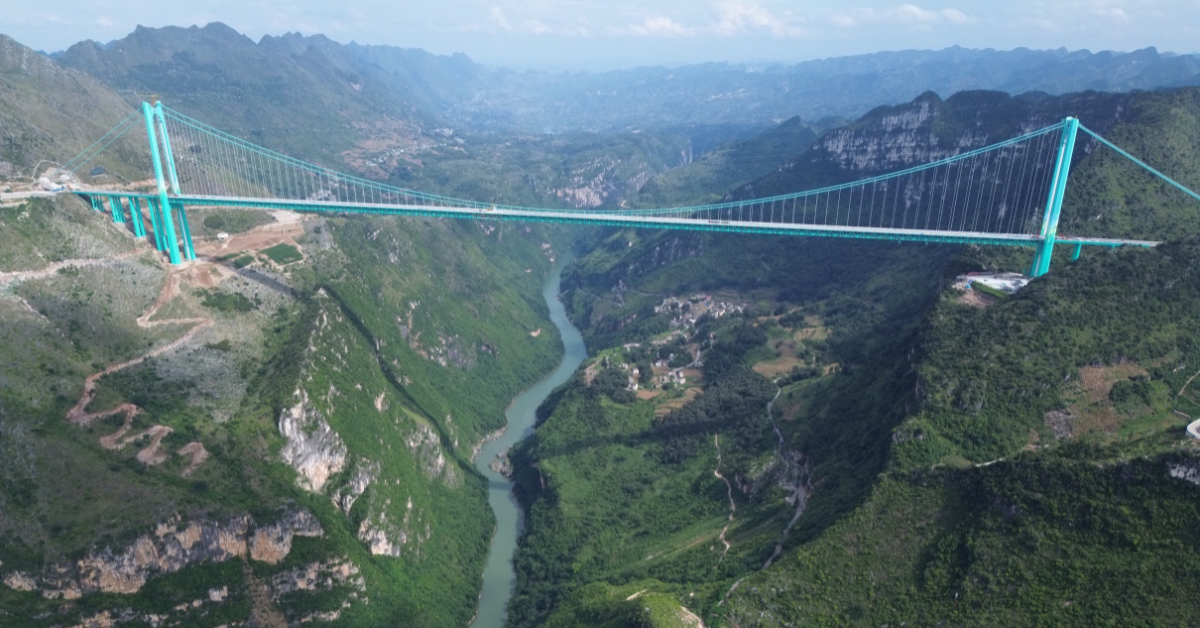
China has once again captured the world’s attention by completing a project that redefines engineering limits. The Huajiang Grand Canyon Bridge, located in Guizhou Province, officially opened to traffic in late September 2025 and now holds the record as the tallest bridge on Earth. Rising an astonishing 625 meters above the Beipan River and stretching nearly 2.9 kilometers, it is a marvel of both design and execution. Beyond its jaw-dropping height, the bridge is expected to deliver enormous economic, social, and cultural benefits to one of China’s less developed regions.
Construction at Record Pace
The project broke ground in January 2022 and was finished in less than four years, a remarkable timeline given the unforgiving terrain. Spanning deep gorges and rugged mountains, the bridge’s main suspension span of 1,420 meters makes it the longest in a mountainous environment. The total cost was around 2.1 billion yuan (about 280 million US dollars), an investment that reflects both the difficulty of the task and its long-term importance.
To ensure safety and durability, engineers carried out extensive load testing, including driving dozens of fully loaded trucks across the structure before its grand opening. Advanced cable systems, wind-resistant technology, and high-strength steel were key to handling the challenging conditions at such dizzying heights.
Why It Stands Out
Several features set the Huajiang Grand Canyon Bridge apart from other world-class structures:
- Record-Breaking Height: With a deck 625 meters above the river, it surpasses all other bridges globally.
- Unprecedented Span in Mountainous Terrain: Constructing a suspension bridge with a span of 1,420 meters in such geography is unprecedented.
- Tourism-Friendly Design: Unlike most functional road bridges, this one is also a tourist destination in its own right, with planned observation decks, glass walkways, and cafes that let visitors experience the canyon from above.
Transforming Regional Connectivity
Perhaps the most dramatic benefit of the bridge is how it slashes travel time. Before, crossing the Huajiang Canyon could take nearly two hours of winding mountain driving. Today, that same journey takes just two minutes. For residents, businesses, and travelers, the time saved is life-changing.
The bridge is part of the Liuzhi–Anlong Expressway (S57), linking parts of Guizhou Province and integrating them more effectively with surrounding cities and trade routes. By easing traffic pressure and creating more direct pathways, it will serve as a vital artery for logistics and commerce.
Economic and Social Benefits
1. Boosting Local Development
Guizhou has long lagged behind coastal provinces in terms of infrastructure and income. The new bridge is expected to narrow that gap by connecting isolated areas to larger markets. Farmers, small manufacturers, and local businesses will be able to move goods more efficiently, lowering costs and increasing competitiveness.
2. Tourism Growth
The Huajiang Canyon itself is a natural wonder, and the bridge adds a spectacular human-made attraction. Tourism planners are already preparing skywalks, scenic elevators, and adventure sports in the surrounding area. This could turn the region into a new hotspot for domestic and international travelers, generating jobs and revenue.
3. Social Integration
Improved accessibility doesn’t just mean better trade — it also strengthens community ties. Education, healthcare, and employment opportunities in nearby towns and cities will now be much easier to reach. For many villagers, the bridge literally connects them to better futures.
4. Showcasing National Expertise
On a broader scale, the bridge is a showcase of China’s engineering capabilities. Building such a complex structure at a relatively modest cost, in record time, demonstrates technical leadership. It also signals how infrastructure remains central to China’s strategy for balancing development between urban centers and rural provinces.
Challenges and Considerations
Like any megaproject, the Huajiang Bridge comes with challenges. Construction in a fragile ecosystem raises environmental concerns, and authorities will need to ensure that tourism and development do not damage the canyon’s natural beauty. Maintaining safety for drivers and visitors at such extreme heights is also critical. Additionally, the long-term economic return will depend on whether the surrounding region fully leverages the bridge’s potential.
A Bridge to the Future
At its core, the Huajiang Grand Canyon Bridge is more than a feat of steel and concrete. It is a symbol of connection: between remote mountain communities and urban centers, between economic stagnation and opportunity, and between the natural and human-made worlds.
By shrinking travel times from hours to minutes, opening new economic corridors, and inviting the world to marvel at both the canyon and the structure itself, the bridge stands as a powerful testament to how infrastructure can transform lives.
For China, it’s another landmark achievement in its ongoing story of rapid development. For the world, it’s a reminder that even the steepest divides can be bridged when ambition meets engineering.